Action
In
action films, the protagonist is mainly a big, muscular guy who can tackle danger and take on anyone. They tend to be invincible and
impossible to kill, and are often captured but not killed when the
antagonist has the chance. Examples of these protagonists are Jason Bourne from 'The Bourne Identity' and Barney Ross of
the 'Expendables' franchise. Bryan Mills from 'Taken' can't be stopped, but he isn't a huge
bodybuilder - he's an ex-CIA agent who has the "unique set of skills" so he
doesn't need to be the stereotypical clichés of other movies, and is driven by the motivation to find his
kidnapped daughter. Because of this, 'Taken' is a much more realistic
thriller than something similarly plotted like 'Expendables' for example.

 'Taken' is a great example where this cliché has not been used to the extreme as Bryan Mills is middle-aged, is not built like a bodybuilder and is probably not in the peak of his fitness. This was made clear at
the time when he is chasing a suspect to may have information to his daughter's whereabouts. The suspect is a younger male who is clearly fitter and healthier than Mills however Mills uses a car to catch up with him, this becomes more realistic than having Mills running after this man who is clearly no match from him. But this has incidentally become an entire cliché of its own as Byran Mills eventually finds his daughter and brings her kidnappers to his form of justice, single-handedly. An example of
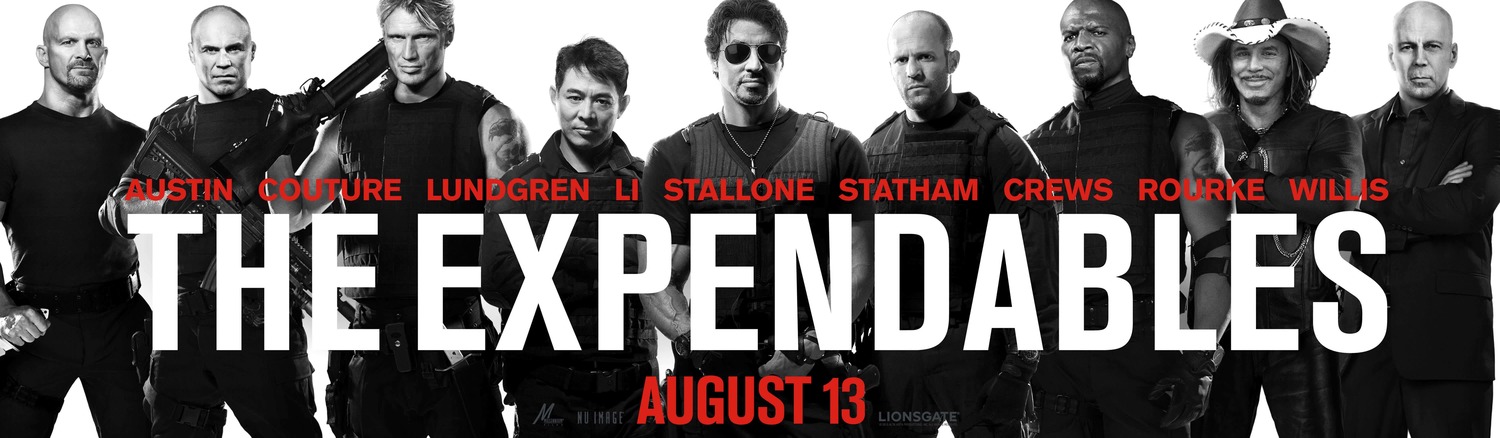
this scenario is 'Expendables', with Sylvester Stallone as Barney Ross and more notable actors who are part of this elite group of mercenaries called the 'Expendables'. The group starts off in the Gulf of Aden to save hostages on a vessel from Somali pirates.
The team consists of leader Barney Ross (Sylvester Stallone), blades specialist Lee
Christmas (Jason Statham), martial artist expert Yin Yang (Jet Li), the loose cannon Gunner Jensen (Dolph Lundgren), weapons specialist
Hale Caesar (Terry Crews), and demolitions expert Toll Road (Randy Couture). Jensen instigates a
firefight, causing casualties for the pirates. He then tries to hang a
pirate, but Yang stops him when Ross and the team discourage it. Ross
reluctantly discharges him from the team. Later, the team is called to do a job in Vilena, an island in the Gulf of Mexico. The
antagonist firstly appears to be a dictator called General Garza (David Zayas), both the team and the General realize that they share a common enemy the film's true antagonist is ex-CIA officer James Munroe (Eric Roberts) is keeping General Garza in power as a figurehead for his own profiteering operations. A typical costume for the protagonist in 'Taken' is Bryan Mills' black leather jacket which he wear in almost every scene, very plain and basic. The
villains will wear suits and causal clothes depending on the scene, and the women will wear skimpy dresses and very little items of clothing to go with that,
very gender-specific clothing to distinguish them as the feminine
counterparts of masculine male characters. In this film the males are dominant throughout and the women are helpless in every scene in comparison to the males. In 'Expendables' however the team all wear black but combat gear due to their environment and situation. Both 'Taken' and 'Expendables' uses fast paces camera shots to quicken the rhythm of the film as they try to follow the audience expectations of a modern action film. The lighting in 'Taken' is usually very dark to create this harsh, brutal atmosphere to fit into the situation the characters find themselves in. 'Expendables' varies as when they are away from the action the lighting is very bright and friendly when they are not being shot at or killed people, however when they inevitably suit up for the action the scenes are usually filmed in the night to show that they do not what to be revealed to either enemies or audience, gives everyone as sense of surprise. The characteristics of both films main protagonists are very similar as when they are with the people they love and care about they are very calm and relaxed, this is a complete contrast with their other personality when they are thrown into the hot seat and become hard and cold in order to complete their task.
'Taken' is a great example where this cliché has not been used to the extreme as Bryan Mills is middle-aged, is not built like a bodybuilder and is probably not in the peak of his fitness. This was made clear at
the time when he is chasing a suspect to may have information to his daughter's whereabouts. The suspect is a younger male who is clearly fitter and healthier than Mills however Mills uses a car to catch up with him, this becomes more realistic than having Mills running after this man who is clearly no match from him. But this has incidentally become an entire cliché of its own as Byran Mills eventually finds his daughter and brings her kidnappers to his form of justice, single-handedly. An example of
this scenario is 'Expendables', with Sylvester Stallone as Barney Ross and more notable actors who are part of this elite group of mercenaries called the 'Expendables'. The group starts off in the Gulf of Aden to save hostages on a vessel from Somali pirates.
The team consists of leader Barney Ross (Sylvester Stallone), blades specialist Lee
Christmas (Jason Statham), martial artist expert Yin Yang (Jet Li), the loose cannon Gunner Jensen (Dolph Lundgren), weapons specialist
Hale Caesar (Terry Crews), and demolitions expert Toll Road (Randy Couture). Jensen instigates a
firefight, causing casualties for the pirates. He then tries to hang a
pirate, but Yang stops him when Ross and the team discourage it. Ross
reluctantly discharges him from the team. Later, the team is called to do a job in Vilena, an island in the Gulf of Mexico. The
antagonist firstly appears to be a dictator called General Garza (David Zayas), both the team and the General realize that they share a common enemy the film's true antagonist is ex-CIA officer James Munroe (Eric Roberts) is keeping General Garza in power as a figurehead for his own profiteering operations. A typical costume for the protagonist in 'Taken' is Bryan Mills' black leather jacket which he wear in almost every scene, very plain and basic. The
villains will wear suits and causal clothes depending on the scene, and the women will wear skimpy dresses and very little items of clothing to go with that,
very gender-specific clothing to distinguish them as the feminine
counterparts of masculine male characters. In this film the males are dominant throughout and the women are helpless in every scene in comparison to the males. In 'Expendables' however the team all wear black but combat gear due to their environment and situation. Both 'Taken' and 'Expendables' uses fast paces camera shots to quicken the rhythm of the film as they try to follow the audience expectations of a modern action film. The lighting in 'Taken' is usually very dark to create this harsh, brutal atmosphere to fit into the situation the characters find themselves in. 'Expendables' varies as when they are away from the action the lighting is very bright and friendly when they are not being shot at or killed people, however when they inevitably suit up for the action the scenes are usually filmed in the night to show that they do not what to be revealed to either enemies or audience, gives everyone as sense of surprise. The characteristics of both films main protagonists are very similar as when they are with the people they love and care about they are very calm and relaxed, this is a complete contrast with their other personality when they are thrown into the hot seat and become hard and cold in order to complete their task.
Comedy
In comedy films, the protagonist is stereotypically a person who is dopey and clumsy who can be childish and very unreliable. They are usually outnumber and excluded by others and they may be part of a small group of friends or one sole friend, best friend. Examples of these are Brennan Huff (Will Ferrell) and Dale Doback (John C. Riley) from 'Step Brothers' and Ron Burgundy of 'Anchorman: The Legend of Ron Burgundy' and 'Anchorman 2: The Legend Continues'. Will Ferrell from both films acts like a man-child in the way that they are dependent of someone else and also do adult acts like drinking and swearing excessively, John C. Riley can be put in the category of both Will Ferrell's characteristics.

'Step Brothers' is a very clichéd example that incorporates the stereotypical, comical protagonist as both Ferrell and Riley are two forty year-old men who still live with each others' parent. Ferrell lives with his mother, played by Mary Steenburgen, and Riley lives with his father Richard Jenkins, the two parents both attend a conference in which Robert Doback (Richard Jenkins) is talking about his medical profession and the technology he uses. While making the speech Richard Doback's and Nancy Huff's (Mary Steenburgen) eyes meet and Richard freezes. Eventually the film is sped up to present day to showing a quick insight to their marriage ceremony, where both Brennan and Dale act like children and storm out of the ceremony through different exits. When the film finally comes to present day we find the two step brothers believe that they are two very different people with different views, we, the audience, know this not to be true as only about ten minutes into the film and we can clearly see a connection and similarity between the two. Throughout their first first weeks together they have a burning hatred for the other as they play childish and idiotic pranks on each other which normal ends up in them fighting. This is extremely hilarious to watch and the two purposefully become part of the stereotypical cliché acting in this childish-like behavior that inevitably gets them in trouble with their parents. Eventually as the film progresses the brothers form a stronger bond that is stronger than if they were actual blood brothers from then on the film gets more and more gut-bustingly funny as they continue their ways. Will Ferrell's other outrageous character of Ron Burgundy is also one of Ferrell's best creations with his witty humor, childish acts and typical 1970s macho man look and attitude, however this is alter throughout the length of the film as Burgundy reveals to us that is plays the flute, enjoys poetry and cries like a child when his dog Baxter is thought to have been killed by an angry biker portrayed by Jack Black. Ron Burgundy is the famous anchorman for a local San Diego
television station, fictional KVWN channel 4. He works alongside his
friends on the news team: lead field reporter Brian Fantana (Paul Rudd), sportscaster Champ Kind (David Koechner), and intellectually disabled chief meteorologist Brick Tamland (Steve Carell). Station director Ed Harken (Fred Willard)
notifies the team that they have maintained their long-held status as
the highest-rated news program in San Diego, leading them to throw a
wild party, where Ron unsuccessfully tries to pick up a beautiful,
blonde woman (Christina Applegate).
Ed later informs the team that they have been forced to hire Veronica
Corningstone, the same woman whom Ron tried to pick up. After a series
of inept attempts by the team to seduce her, she finally relents and
consents to a "professional tour" of the city with Ron, culminating in a
sexual relationship. Despite agreeing to keep the relationship
discreet, Ron announces it on air. Inevitably the couple breakup due to their differents. During a big part of the film the sexist male roles try to get Corningstone fired as they there common products of their society as they think the woman cannot do a man's job. Ferrell's comical material relishes the film and makes the film an instant laugh out comedy. The costumes in 'Anchorman: The Legend of Ron Burgundy' are very typical to the film setting and all the main male characters where suits and the women wear smart dresses, whereas in 'Step Brothers' both Brennan and Dale dress very unconventionally for example they both go for job interviews together wearing tuxedos. The lighting in both films is very bright so represents happiness and joy, this is mainly the type of lighting in comedies. The camera shots are usually relaxed to go with the mood and speed of the film as this is a comedy it is very calm and not rushed.

Horror
In clichéd horror films, there is usually a group of teenagers with one clear protagonist, the film contains the athlete, the flirtatious girl (who usually is the love interest of the athlete), the smart on or the brains, the clumsy and foolish character and the shy protagonist (usually a female but on occasion a male). They are normally Go to a haunted houses or places where something horrific occurred so many years ago. Examples of this are 'The Cabin in the Woods' with Dana Polk (Kristen Connolly) as the main protagonist as the "Virgin", Curt Vaughan (Chris Hemsworth) as the "Athlete", Jules Louden (Anna Hutchison) as the "Whore", as Marty Mikalski (Fran Kranz) as the "Fool" and Holden McCrea (Jesse Williams) as the "Scholar". Also including 'The Conjuring' which is not the stereotypical horror theme film. This film is apparently based on true events that happened in 1971 with the Perrons family house in Harrisville, Rhode Island, US was haunted by a witch who lived in the early 19th century, named Bathsheba Sherman, cursing the land so that whoever moved there somehow died. Ed and Lorraine Warren were the paranormal investigators who investigated this case, in the film adaptation Ed is portrayed by Patrick Wilson and Lorraine played by Vera Farmiga. In the 2013 film, 'The Conjuring', directed by James Wan Lorraine Warren was a consultant to the production and appeared in a cameo role in the film.

 'Cabin in the Woods' starts as an non-clichéd horror film as the audience are first introduced to two man working from a hidden underground facility, senior technicians
Gary Sitterson (Richard Jenkins) and Steve Hadley (Bradley Whitford) discuss plans for a mysterious ritual,
reportedly one of several taking place around the world. Specialist
Wendy Lin (Amy Acker) discloses that a similar operation undertaken by their Swedish
counterparts has just ended in failure. Meanwhile, American college students Dana Polk, Holden McCrea, Marty
Mikalski, Jules Louden, and Curt Vaughan are spending their weekend at a
seemingly deserted cabin in the forest. It soon becomes clear that
Sitterson and Hadley are manipulating this setting from afar, even
intoxicating the teenagers with psychotropic drugs that gradually hinder
rational thinking while increasing libido. After the door to the cabin's darkened cellar swings open on its own during a tipsy game of Truth or Dare, for example, both technicians coerce their charges into investigating the contents within. This toxic drug they give the students (in the form of gas) makes each individual student to act like the stereotypical horror victims you see in past film relevant to this genre. However, 'The Conjuring' is set in 1971 where Roger Perron (Ron Livingston) and Carolyn Perron (Lil Taylor) move into a dilapidated farmhouse in Harrisville, Rhode Island, US with their five daughters Andrea, Nancy, Christine, Cindy, and April.
During the first day, their move goes smoothly, though their dog Sadie
refuses to enter the house and one of the daughters finds a boarded up
entrance to a cellar. The next morning, Carolyn wakes up with a mysterious bruise and Sadie
is found lying dead outside the house by April, the youngest daughter,
who also finds a strange music box. All the clocks have also stopped at
3:07. Over the next several days, various instances of paranormal
disturbance occur, most notably when Christine and Nancy are attacked
one night by an unseen figure behind their door; the activity culminates
one night while Roger is away in Florida. After hearing various
clapping and giggling noises, and seeing the picture frames shattered on
the stairs, Carolyn is locked up in the cellar. Later Cindy, one of the
daughters, is awakened after sleepwalking into her sister Andrea's room
and she sees a spirit on top of a wardrobe in the room that leaps on
and attacks Andrea. Carolyn contacts noted paranormal investigators Ed and Lorraine Warren, who agree to take on the case, having recently finished up a case involving a possessed doll called Annabelle (who appears in the sequel). The Warrens conduct an initial investigation and conclude that the house may require an exorcism, but they needed authorization from the Catholic Church and further evidence before they can proceed. The make-up in both films is fantastic, they are well detailed in order make them both terrifying and grotesque. The costumes in 'Cabin in the Woods' are very modern due to the time period being present day but some of the monsters and ghosts dress in their time period, where a family of spirits are dressed in early 19th century clothing and because 'The Conjuring' is set in the 1970s the clothing is very ordinary to then and the spirits that are in the house are clothed in 19th century clothing. The camera angles in both start of slow and casual to set the slow pace atmosphere of peace and tranquility then when the chaos starts the camera angle are faster and more dramatic with dutch camera angle to show the charters stress and strain to fight for their lives.
'Cabin in the Woods' starts as an non-clichéd horror film as the audience are first introduced to two man working from a hidden underground facility, senior technicians
Gary Sitterson (Richard Jenkins) and Steve Hadley (Bradley Whitford) discuss plans for a mysterious ritual,
reportedly one of several taking place around the world. Specialist
Wendy Lin (Amy Acker) discloses that a similar operation undertaken by their Swedish
counterparts has just ended in failure. Meanwhile, American college students Dana Polk, Holden McCrea, Marty
Mikalski, Jules Louden, and Curt Vaughan are spending their weekend at a
seemingly deserted cabin in the forest. It soon becomes clear that
Sitterson and Hadley are manipulating this setting from afar, even
intoxicating the teenagers with psychotropic drugs that gradually hinder
rational thinking while increasing libido. After the door to the cabin's darkened cellar swings open on its own during a tipsy game of Truth or Dare, for example, both technicians coerce their charges into investigating the contents within. This toxic drug they give the students (in the form of gas) makes each individual student to act like the stereotypical horror victims you see in past film relevant to this genre. However, 'The Conjuring' is set in 1971 where Roger Perron (Ron Livingston) and Carolyn Perron (Lil Taylor) move into a dilapidated farmhouse in Harrisville, Rhode Island, US with their five daughters Andrea, Nancy, Christine, Cindy, and April.
During the first day, their move goes smoothly, though their dog Sadie
refuses to enter the house and one of the daughters finds a boarded up
entrance to a cellar. The next morning, Carolyn wakes up with a mysterious bruise and Sadie
is found lying dead outside the house by April, the youngest daughter,
who also finds a strange music box. All the clocks have also stopped at
3:07. Over the next several days, various instances of paranormal
disturbance occur, most notably when Christine and Nancy are attacked
one night by an unseen figure behind their door; the activity culminates
one night while Roger is away in Florida. After hearing various
clapping and giggling noises, and seeing the picture frames shattered on
the stairs, Carolyn is locked up in the cellar. Later Cindy, one of the
daughters, is awakened after sleepwalking into her sister Andrea's room
and she sees a spirit on top of a wardrobe in the room that leaps on
and attacks Andrea. Carolyn contacts noted paranormal investigators Ed and Lorraine Warren, who agree to take on the case, having recently finished up a case involving a possessed doll called Annabelle (who appears in the sequel). The Warrens conduct an initial investigation and conclude that the house may require an exorcism, but they needed authorization from the Catholic Church and further evidence before they can proceed. The make-up in both films is fantastic, they are well detailed in order make them both terrifying and grotesque. The costumes in 'Cabin in the Woods' are very modern due to the time period being present day but some of the monsters and ghosts dress in their time period, where a family of spirits are dressed in early 19th century clothing and because 'The Conjuring' is set in the 1970s the clothing is very ordinary to then and the spirits that are in the house are clothed in 19th century clothing. The camera angles in both start of slow and casual to set the slow pace atmosphere of peace and tranquility then when the chaos starts the camera angle are faster and more dramatic with dutch camera angle to show the charters stress and strain to fight for their lives.
 Don Draper (portrayed by Jon Hamm) is a character from the drama series 'Mad Men'. He is a stereotypical character due to his surroundings being very
male-orientated (considering that the show takes place during the nineteen-sixties) and he has become a product of his society. He has gone through two marriages (one to Betty and the other to
Megan) during which he often committed adultery, an act that would be considered highly improper for any of the female characters in the series to commit. He is only driven by his work even though he has a wife and kids at home and can never seem to make time for them. He is seen as an alcoholic and chain smoker compared to contemporary society, however all his male co-workers do the same, as they too are products of their society and upbringings.
Don Draper (portrayed by Jon Hamm) is a character from the drama series 'Mad Men'. He is a stereotypical character due to his surroundings being very
male-orientated (considering that the show takes place during the nineteen-sixties) and he has become a product of his society. He has gone through two marriages (one to Betty and the other to
Megan) during which he often committed adultery, an act that would be considered highly improper for any of the female characters in the series to commit. He is only driven by his work even though he has a wife and kids at home and can never seem to make time for them. He is seen as an alcoholic and chain smoker compared to contemporary society, however all his male co-workers do the same, as they too are products of their society and upbringings. From his introduction in the show's pilot episode, Walter comes across as a very submissive and introverted character, who slightly resembles the goody two-shoes neighbour Ned Flanders from the animated satirical series 'The Simpsons'. It is not until after he receives the devastating news that he has lung cancer (still in the pilot episode) that Walter decides to "break bad" as it were by adopting a "tough guy" attitude and coming to the conclusion that the only way to resolve his financial worries and support his family is to team up with Jesse Pinkman, a drug dealer and former student of his. Walter blackmails Jesse into helping him cook and distribute methamphetamine - due to Jesse's penchant for drug dealing - or else turning him over to the DEA; Jesse reluctantly agrees.